
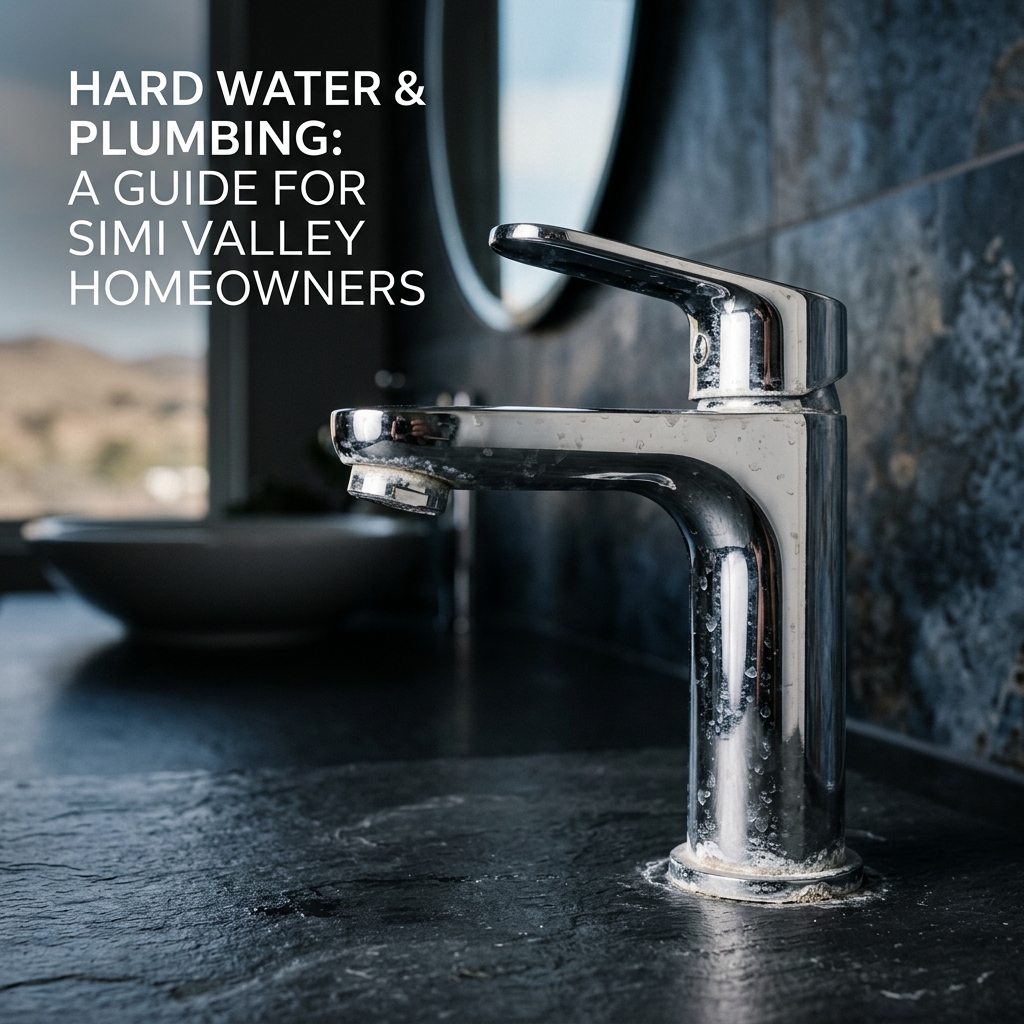
If you've replaced the same faucet cartridge twice in three years, or your showerhead is caked with white buildup no matter how often you clean it, hard water is very likely the reason. This isn't a Simi Valley-specific mystery — it's a known, documented part of the water here — but most homeowners never connect the dots between "why do things keep breaking" and what's actually coming out of the tap.
This guide explains what hard water is, why it's common in Simi Valley specifically, how to find your own household's actual number, and what it's realistically doing to your fixtures and appliances over time.
What Is Hard Water, Exactly?
Hard water is water with a higher-than-average amount of dissolved minerals in it — mainly calcium and magnesium. It's not a safety issue on its own; the EPA doesn't regulate hardness as a health contaminant. What it does affect is everything in your home that water passes through repeatedly: fixtures, pipes, appliances, and anything that heats water.
Hardness is measured in grains per gallon (gpg). The general classification, from the Water Quality Association, is:
| Classification | Grains Per Gallon (gpg) |
|---|---|
| Soft | 0–3.5 |
| Moderately hard | 3.5–7.0 |
| Hard | 7.0–10.5 |
| Very hard | Over 10.5 |
Why Does Simi Valley's Water Run Hard?
Simi Valley is served by two separate water suppliers, and this matters more than most homeowners realize: roughly two-thirds of the city gets water from the City of Simi Valley/Ventura County Waterworks District No. 8, while the remaining third is served by Golden State Water Company, a private utility. Each publishes its own annual water quality report, and hardness can differ somewhat between the two.
The District's water comes mostly from imported sources — primarily through the Calleguas Municipal Water District, which draws from the State Water Project and is treated before reaching Simi Valley homes — supplemented by local groundwater wells in the Tapo Canyon area. Imported surface water from Northern California reservoirs and local Southern California groundwater both commonly carry a meaningful natural mineral content, which is a well-documented characteristic across much of this part of the state, not unique to any one neighborhood.
How Do I Find My Household's Actual Hardness Number?
Since Simi Valley has two suppliers, the most accurate answer is to check your own. Both are required by California law (Health & Safety Code §116470) to publish an annual Consumer Confidence Report:
- City of Simi Valley/Ventura County Waterworks District No. 8: available at simivalley.org, or by calling (805) 583-6469
- Golden State Water Company: available directly through their customer reporting for the Simi Valley service area
Your water bill will typically tell you which supplier serves your address if you're not sure.
What Hard Water Is Actually Doing to Your Home
Faucets and Fixtures
Mineral deposits build up inside faucet cartridges and valve mechanisms over time, causing drips, reduced flow, and premature failure. This is one of the most common reasons a faucet that should last a decade needs a faucet cartridge replacement within a few years.
Showerheads
The small spray holes in a showerhead are exactly the right size to clog with mineral scale, which is why flow gets weaker and more uneven over time even though nothing is technically "broken."
Garbage Disposals
Mineral buildup around seals and moving parts contributes to premature wear, on top of normal use. If your unit is jamming or leaking, see our garbage disposal service options.
Water Heaters
Minerals settle out as sediment inside a water heater tank, which reduces efficiency over time and can shorten the unit's effective lifespan.
Dishwashers and Washing Machines
Hard water is a common cause of cloudy glassware, spotting, and reduced detergent effectiveness, since minerals interfere with how soap and detergent work.
Does a Water Softener Fix Everything?
A whole-house water softener addresses the mineral content at the source and can meaningfully reduce scale buildup going forward. It's a bigger investment and a separate decision from fixture-level repair — installing or maintaining a whole-house softener system is typically plumbing work beyond simple fixture repair, and worth discussing with whoever handles that scope of work for your home.
For many homeowners, the more immediate and lower-cost approach is simply expecting fixture-level parts to wear faster here than the national average, and budgeting for that rather than treating each failure as a surprise. Check our Simi Valley seasonal maintenance checklist for ongoing inspection tips.
When Should You Call Someone vs. Handle It Yourself?
Many hard-water symptoms are simple, low-cost fixes: a cartridge swap, a showerhead soak-and-clean, a disposal service. These are reasonable for a comfortable DIYer. It's worth calling a professional when:
- A fixture has failed more than once in a short period, which can point to a larger issue than a single worn part
- You're noticing reduced water heater efficiency or unusual noise (sediment buildup)
- You're considering a whole-house softener or filtration system, which is a bigger decision worth getting real information on first
If you're wondering what typical repairs cost locally, review our breakdown of typical repair costs.
The Bottom Line
Hard water isn't a Simi Valley mystery or a sign that something's wrong with your home specifically — it's a documented characteristic of the water supplied here, tied to where it comes from and how it's treated before it reaches your tap. Knowing which of the city's two suppliers serves your address, and checking their current report, is the most accurate way to understand your own situation.
If fixtures at your house keep wearing out faster than seems normal, that's usually hard water doing exactly what hard water does — and it's worth budgeting for slightly more frequent fixture-level maintenance here than you might expect elsewhere, rather than being caught off guard by it.